 All about product
 Reviews
 Questions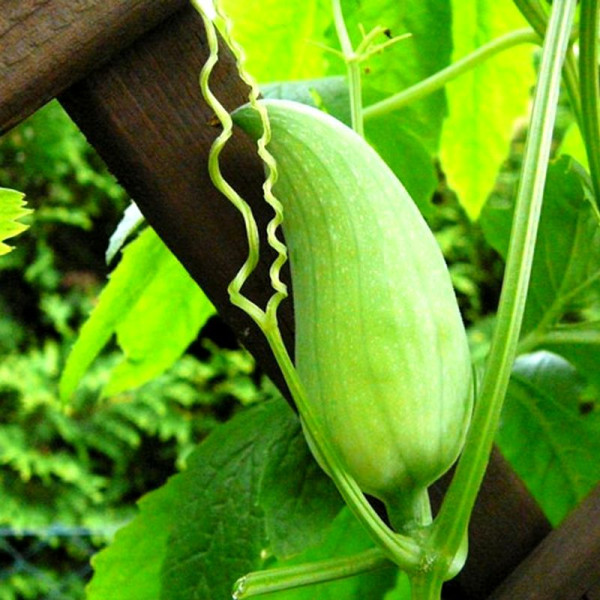


Caigua or Achocha, Achokcha, Caihua, Caygua, Cayua, Korila, Wild Cucumber / Cyclanthera pedata
Species of plants from the genus Cyclanthera of the Cucurbitaceae family, cultivated in countries with tropical and subtropical climates for the sake of edible fruits. The homeland of the species is South America.
An annual powerful herbaceous liana with a large number of shoots, up to 5 meters long, clinging to a support with antennae. The leaves are alternate, up to 20 cm in circumference, finger-like dissected almost to the base into 5-7 lobes, giving the plant a high decorative effect.
The flowers are yellow, small (less than a centimeter in diameter), dioecious. Male flowers are collected in panicles 10-20 cm long, consisting of 20-50 flowers.
Fruits are 5-7 cm long and 2.5-3 cm in diameter, elongated-oval, narrowed at both ends, the apex is often curved. The skin is green, and in a state of full ripeness - pale green or cream. The walls of the fruit are about 4 mm thick, juicy. The hollow inner chamber contains 8-10 hard black seeds.
Young fruits are eaten raw (in salads) and stewed, stuffed. The flowers and young shoots are also edible. Edible fruits, similar to small peppers, located in the axils of the leaves. Unripe fruits are eaten fresh, salted, fried, and ripe ones are only fried. They taste like fried beans. The seeds are used in the treatment of hypertension.
The agricultural technique of this plant is somewhat similar to the agricultural technique of cucumbers, but there are some differences. This type of cyclantera grows in the mountains, and therefore does not have special requirements for heat. The optimum temperature for growth and development is about 20C. Cyclantera bears fruit in our latitudes in August.
Seeds are sown directly into the ground in April-May, when the soil temperature reaches 15C, and covered with a film. In warm weather shoots appear quickly - in 3-5 days. When plants have 3-5 true leaves, it is advisable to fertilize with a solution of urea (about 20 grams per bucket of water) or other fertilizers for vegetables, and also install props, as for cucumbers.
During the growing season, it is necessary to carefully monitor the soil moisture. When it dries up, as well as during dry winds, the plant suffers greatly, so it is advisable to plant in places protected from the wind.
Cyclantera can be planted on trees, but may be difficult to harvest. It is best to put it on a gazebo or trellis about 2 meters high.
Top dressing during the growing season is carried out as needed, based on the condition of the plants. If the leaves are dark green, the shoots are actively growing, then feeding is not necessary, but if growth weakens, the leaves turn pale, feeding is necessary. During fruiting, you can feed with a small amount of ash, which is applied using surface loosening.
The plant is self-sterile, i.e. does not produce fruit when pollinated by its own pollen, so a minimum of 2 plants must be planted to produce a crop.
The fruits are harvested when they begin to ripen, which can be judged by their slight yellowing, but in this case they are suitable only for processing. Until they have reached full ripeness, they can be eaten fresh, but then they must be harvested until they have grown more than 1 cm.
The yield of this type of cyclantera in our area is high and is approximately 5-6 kg per bush, so 3 bushes are enough for a family of three.
Seeds for future crops are harvested from well-ripened fruits when they turn completely yellow. Fully ripened seeds are absolutely black. After being removed from the fruit, they are dried on paper and only after that they are stored for storage, similar to cucumber seeds.

There are no reviews for this product, be the first to leave your review.


No questions about this product, be the first and ask your question.


