 All about product
 Specification
 Reviews
 Questions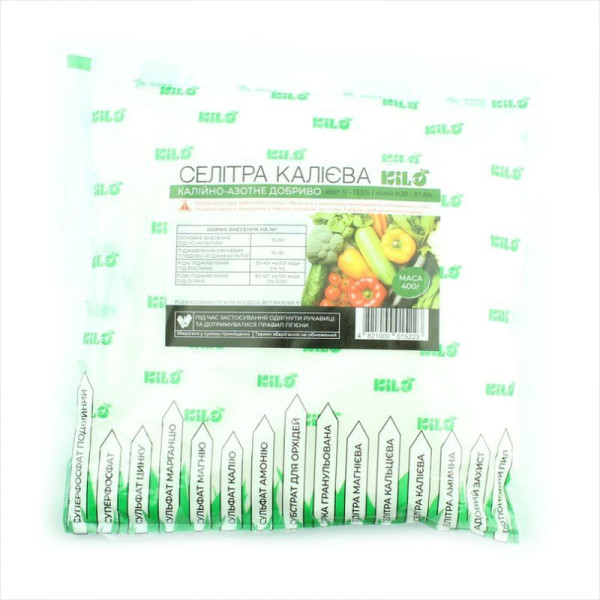


Potassium nitrate (KNO3) - double complex mineral fertilizer consisting of nitrogen and potassium, for various soils, especially for chlorine-sensitive crops: berry and citrus crops, sugar beet, potato, tobacco, grapes, flax, and also used in greenhouse vegetable production and for indoor plants.
Fertilizer composition: nitrogen (N) - 13.5%, potassium (K2O) - 37.6%.
It has excellent properties, has no special restrictions in use, and is quite simple to apply. With the right approach, it can give very impressive results when growing various crops.
Properties:
- increases plant endurance;
- increases yield;
- increases storage life;
- improves the taste and appearance of fruits.
Application: potassium nitrate is widely used for fertilizing vegetable and fruit-berry crops. After applying potassium nitrate, the quality and quantity of the harvest noticeably improves – the flesh is abundantly saturated with fruit sugars that affect the taste of the final product, and the size of fruits and berries increases.
Also, thanks to the application of this fertilizer at the stage of setting ovaries, the keeping quality of fruits improves, and accordingly, their storage life increases. Potassium nitrate is a very good form of potassium fertilizer for potatoes and cabbage. Feeding these crops is carried out during hilling, when the tops are already well developed and excess nitrogen must be avoided; in this case, the fertilizer is effective because its nitrogen content is 3.5 times less than potassium.
The use of potassium nitrate in greenhouse cultivation is promising; its use reduces the overall concentration of salts in the nutrient solution. Since this composition mainly affects active flowering and fruiting, it is not recommended to use it for feeding root crops. It will be enough to apply it as the main fertilizer to the soil in spring before planting plants.
As a top dressing, potassium nitrate is applied from the beginning of bud appearance until fruit ripening. Since the nitrogen content in the fertilizer is low, for fruit trees this is the best option. Keep in mind that starting from the moment of flowering, other nitrogen-containing fertilizers cannot be applied.
Method of application:
1. Root method of plant feeding:
As a fertilizer, potassium nitrate can be applied under plants both in dry and liquid form. Since the solution acts much faster, it is used more often for feeding.
For vegetable and flower crops, a solution of 15–20 g of potassium nitrate per 10 liters of water is prepared and applied approximately once every 10–15 days.
For ornamental and berry shrubs, a solution of 20–25 g per 10 liters of water is used, also once every 10–15 days.
For fruit trees, a solution of 25–30 g per 10 liters of water is used with the same frequency.
2. Foliar feeding:
For foliar feeding, a more concentrated solution can be made, taking into account that part of the fertilizer will be lost after evaporation from the leaves, and also washed off during watering. Therefore, it is desirable to make the maximum possible concentration, about 25 g per 10 liters. The solution is sprayed onto the leaves using a sprayer. During the entire summer period, at least two and no more than four sprayings must be carried out, not forgetting that the last one must be done at least 3-4 weeks before harvesting.
For vegetable and flower crops, as well as strawberries, a solution of 15–20 g per 10 liters of water is prepared, consuming 1–1.5 liters per 10 m². During the growing season, two to four sprayings are carried out.
For ornamental and berry shrubs, a solution of 20–25 g per 10 liters of water is used, consuming about 1.5 liters per bush. During the season, 2–4 treatments are performed.
For fruit trees, a solution of 25–30 g per 10 liters of water is prepared, consuming about 2 liters per young tree and 5–8 liters per adult tree. In total, 2–4 sprayings are carried out during the growing season, with the last treatment done at least 3–4 weeks before harvest.


There are no reviews for this product, be the first to leave your review.


No questions about this product, be the first and ask your question.
