Growing tall tomato varieties and hybrids in open ground without staking is possible, but difficult – it is more practical to plant them in a greenhouse and train them vertically. It is unlikely that you will be able to harvest a rich and healthy crop from vines lying on the ground. Even low-growing bushes often need support.
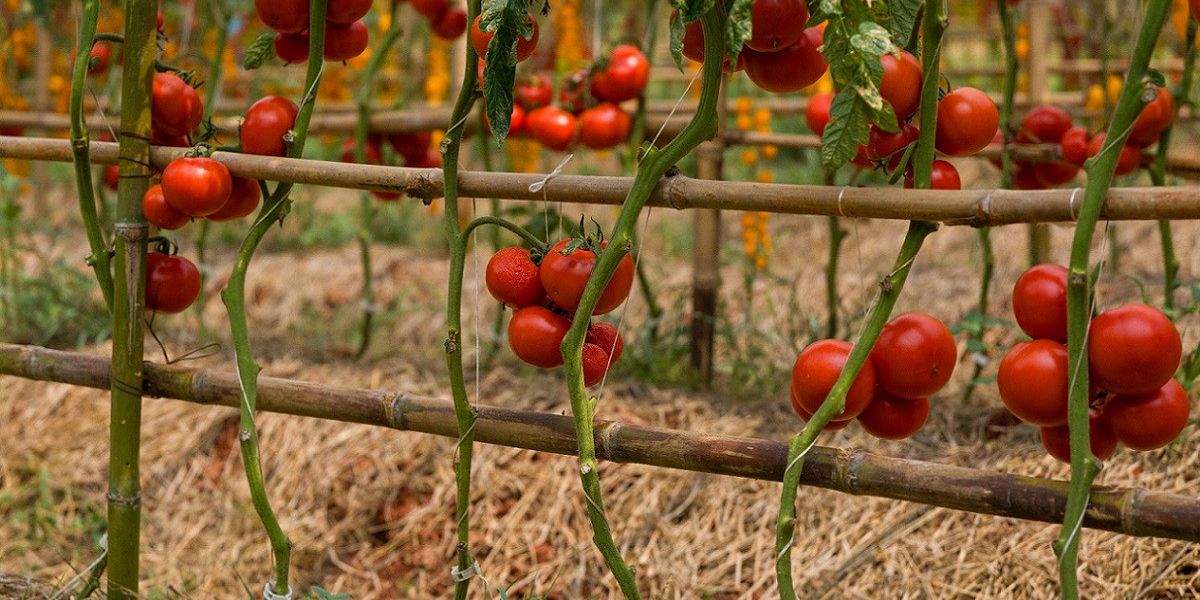
Staking tomatoes is an important agricultural practice that helps maintain plant health and achieve abundant yields. However, many beginner gardeners encounter difficulties and make mistakes when tying up bushes, since it is necessary to choose the right method and support, and this choice depends on the tomato variety and the growing conditions – greenhouse or open ground.
Why stake tomatoes
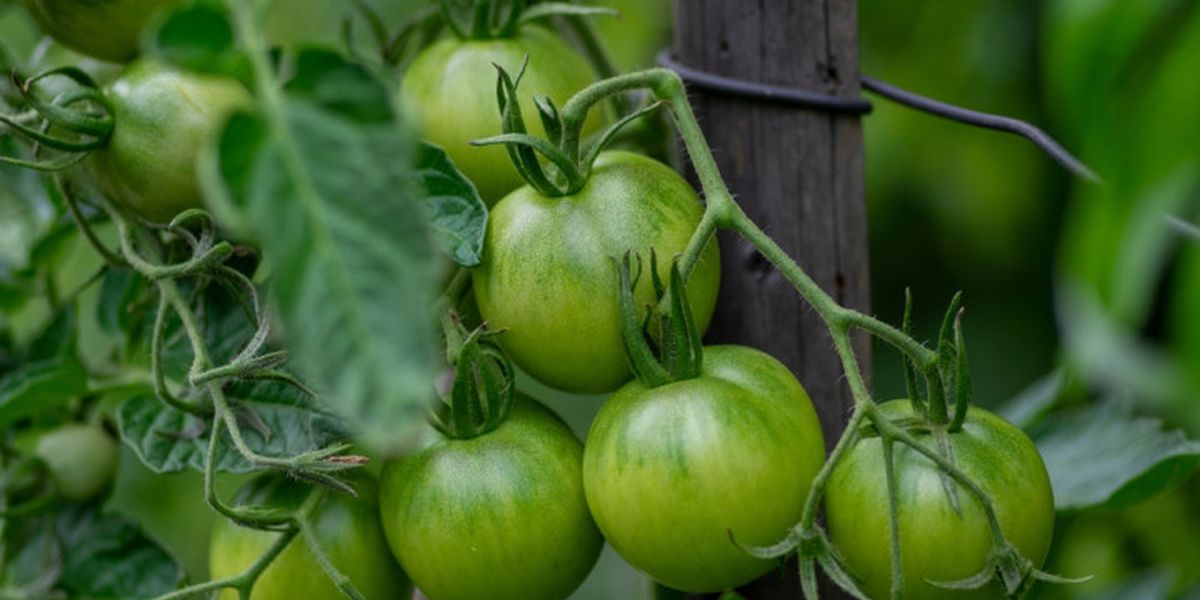
You have probably noticed that tomatoes are quite capable of growing without support – spreading across the ground in a dense plantation. However, most gardeners still prefer to stake them, as this procedure offers significant advantages.
First, by lifting the foliage and fruits higher, we greatly reduce the risk of fungal diseases – both thanks to improved air circulation around the bushes and simply because the plants are farther from the soil, where pathogens live.
Staked tomatoes receive more sunlight, which positively affects their growth and fruiting – the fruits fill out better and ripen faster.
Another advantage is easier maintenance. Vertically supported plants are much more convenient to prune and sucker, as well as to water and fertilize, because the space becomes easier to inspect. In addition, ripe fruits are more visible, making it possible to harvest them on time.
Staking is recommended for tomatoes of all varieties, since branches often break under the weight of heavy clusters and large fruits. However, indeterminate plants require special attention, as they are characterized by unlimited growth. They must be staked, because without support the bushes will simply fall to the ground and become tangled together, or even break completely.
When to stake tomatoes
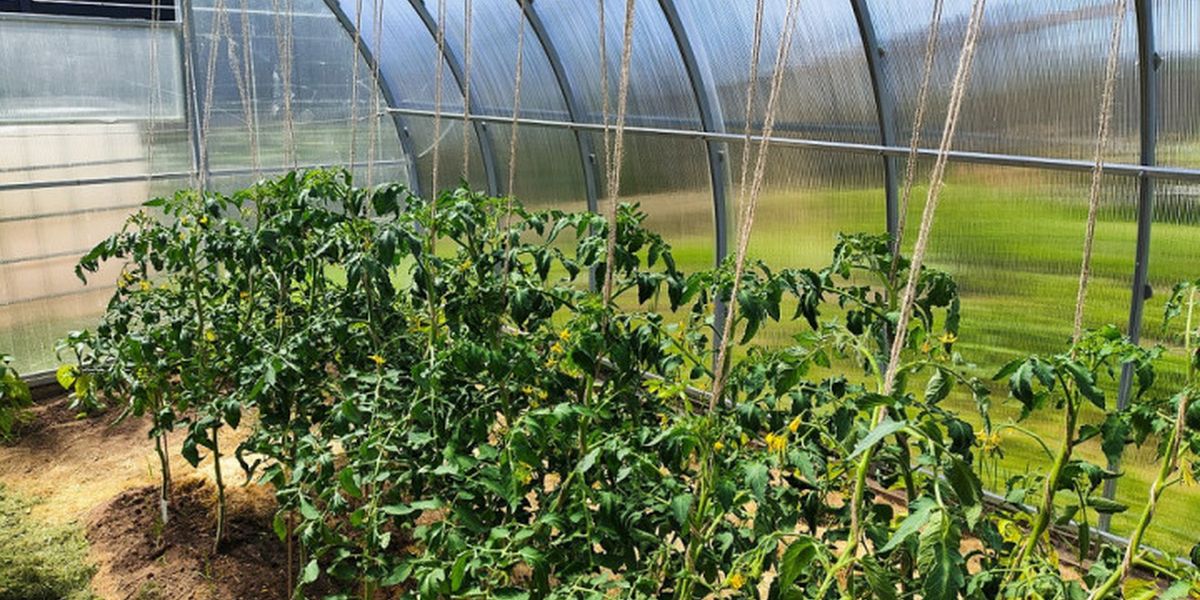
It is recommended to stake tomatoes immediately after planting them in a greenhouse or garden bed, or within the first two weeks (after removing any protective covering used for insulation). It is important to give the plants time to adapt, but also to act before the stem enters its active growth phase and begins to lean toward the ground under its own weight.
One very important nuance: do not water tomatoes immediately before staking. At this moment, the plants should be slightly wilted and flexible – this makes them easier and safer to work with. If the bush is fully saturated with moisture, the shoots become more brittle and can be accidentally damaged more easily. Before staking, any suckers should also be removed.
Choosing a support and staking method for tomatoes
The choice of support depends on the characteristics of the variety. Determinate tomatoes, which are compact and produce their crop over a shorter period, do not require very tall structures – supports about 0.8–1 m high are sufficient. Indeterminate tomatoes, which continue to grow and bear fruit throughout the season, need more substantial support, with an optimal height of approximately 1.5–2 m.
To determine which group the tomatoes in your garden belong to, carefully study the information on the seed packet. After that, it will be easier to select the appropriate staking method and understand how to secure the plants correctly.
Attaching tomato bushes to individual stakes
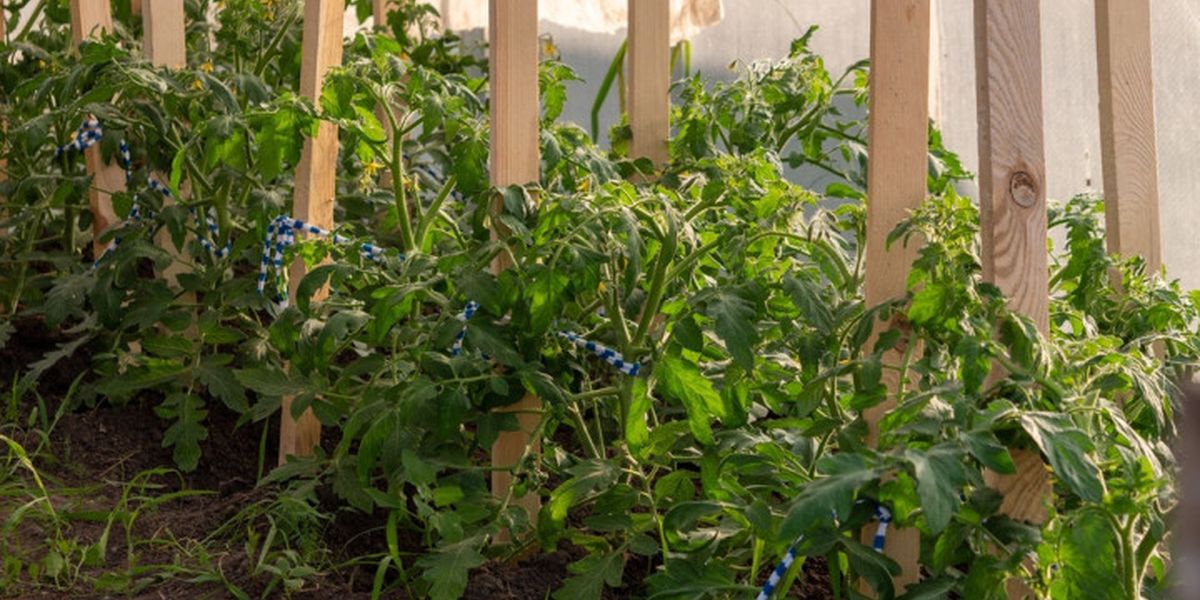
An individual stake is the simplest way to support tomatoes and does not require significant time or expense. This method is especially suitable for determinate varieties and dwarf tomatoes grown in containers.
Various materials can be used for this purpose – some can be purchased ready-made (for example, metal T-shaped supports or stakes coated with plastic), while others are often available around the household (such as wooden bars left over from construction projects or pruned branches from fruit trees).
It is advisable to use stakes or bars that are at least 20–25 cm taller than the expected height of the tomato bushes, so that as the plants grow, it will still be possible to tie up their tops.
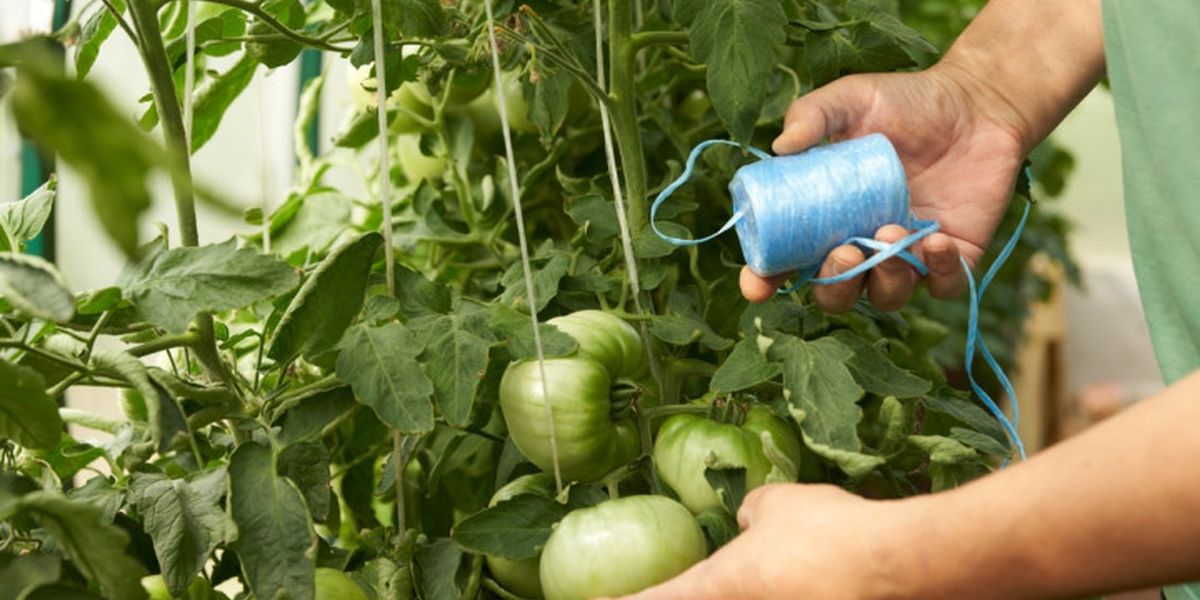
The support is placed about 10 cm from the base of the bush and driven into the soil to a depth of approximately 30 cm. If the soil is loose, the stake should be inserted deeper to ensure stability and reliable support. As the tomato grows, the stem is gradually tied to the stake every 15–30 cm. Twine, jute rope, or soft strips of elastic fabric can be used for fastening, as these materials will not damage the plant stem.
Staking tomatoes to a trellis
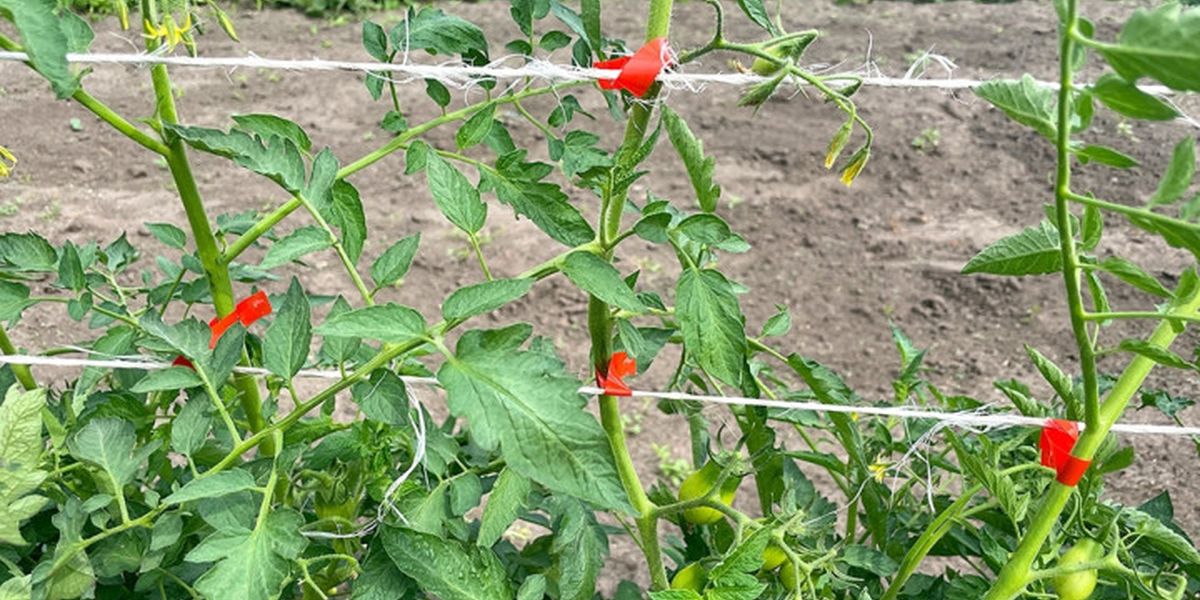
This method involves building a more complex structure, but it has proven to be the most reliable way to support tall tomatoes. The trellis may consist of support posts with ropes stretched between them or a ready-made mesh panel. Plants can also be tied to the upper horizontal beam of a greenhouse by draping ropes over it and fastening them around the stems with a loose loop.
To create a horizontal trellis, support elements such as metal rods, long wooden stakes, or timber posts are inserted into the ground along the entire bed. Then twine, wire, or long rods are stretched between them in several levels spaced 25–30 cm apart. As the tomato plants grow, their stems are guided between these horizontal rows, and when forming bushes with 2–3 stems, the side shoots are also carefully woven between them, providing support from all sides.
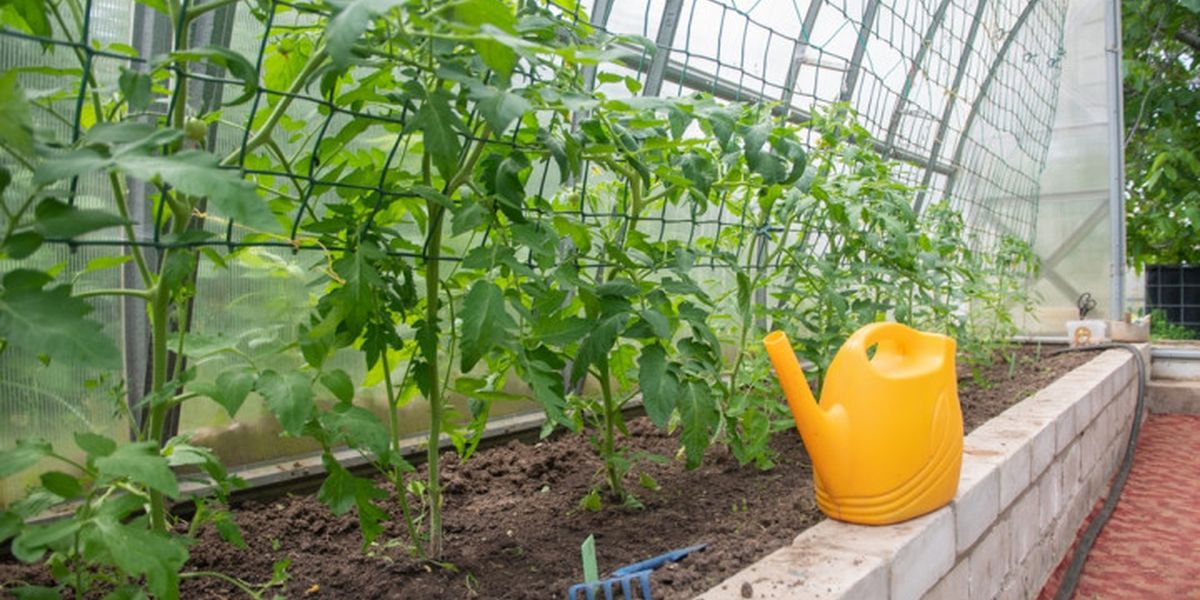
Sometimes two-meter mesh panels are used as trellises and installed between rows of tomatoes. The mesh can be secured in different ways: for example, tied to side supports placed at the ends of the bed or stretched between the greenhouse's upper crossbeam and metal anchors fixed in the soil. Tomato stems are tied to the mesh using twine, cord, knitted thread, or plastic clips.
The main advantage of this construction is its flexibility. As the bushes grow, they can easily be untied from one section of the mesh and reattached higher up, adapting the support to the plant's current size. In addition, this method eliminates the need to install individual stakes for every bush – a single mesh can support several plants at once, significantly saving both labor and materials.
Installing a wire frame for tomatoes
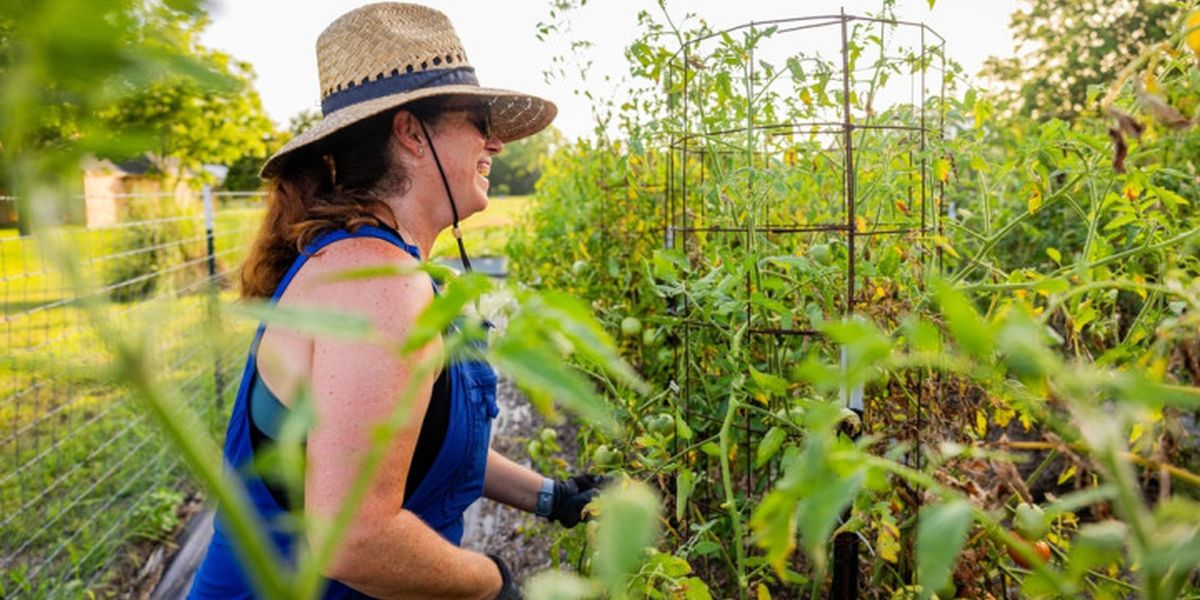
A cylindrical wire frame is best suited for supporting determinate tomatoes, which are generally compact and densely foliated. Indeterminate plants require taller and sturdier structures capable of withstanding their rapid growth and considerable weight.
Ready-made wire frames (plant supports) can be purchased in stores. However, inexpensive models sometimes fail under the weight of mature bushes and may bend. Therefore, it is preferable either to buy more expensive but reliable supports made from thick wire or to build them yourself using available materials. Keep in mind that both options can become costly when growing a large number of tomato plants.
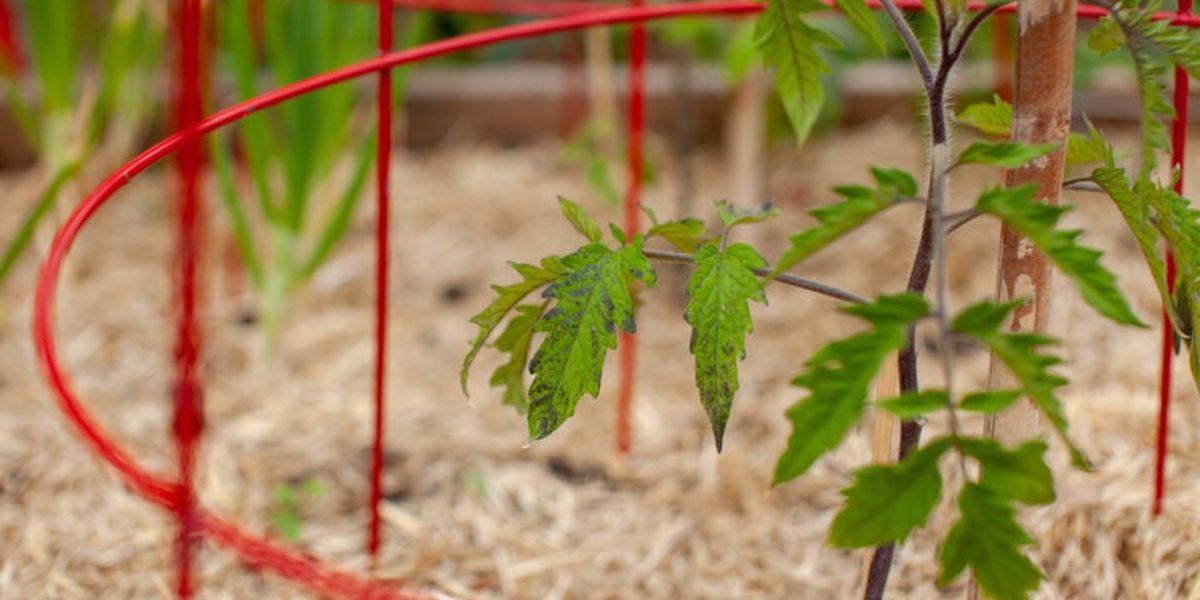
It is best to install the frame immediately after planting: it can either be driven directly into the soil or secured with ground stakes. As the tomato grows, the shoots are carefully tied to the frame so that the bush remains inside the structure. This helps maintain the proper shape of the plant and simplifies maintenance.
Special attention should be paid when growing tomatoes in windy locations or when using this method for indeterminate varieties. In such cases, it is recommended to install several support stakes inside the frame for additional stability. These will keep the heavy upper portions of the plants upright and prevent the structure from tipping over.
Perhaps only the shortest super-determinate and standard tomato varieties can be grown without staking. As a rule, they have thick, sturdy stems capable of supporting several fruit clusters and usually do not require sucker removal. However, tomatoes of all other varieties (including determinate ones) should be provided with additional support to ensure healthy growth and abundant fruit production.
Write a comment